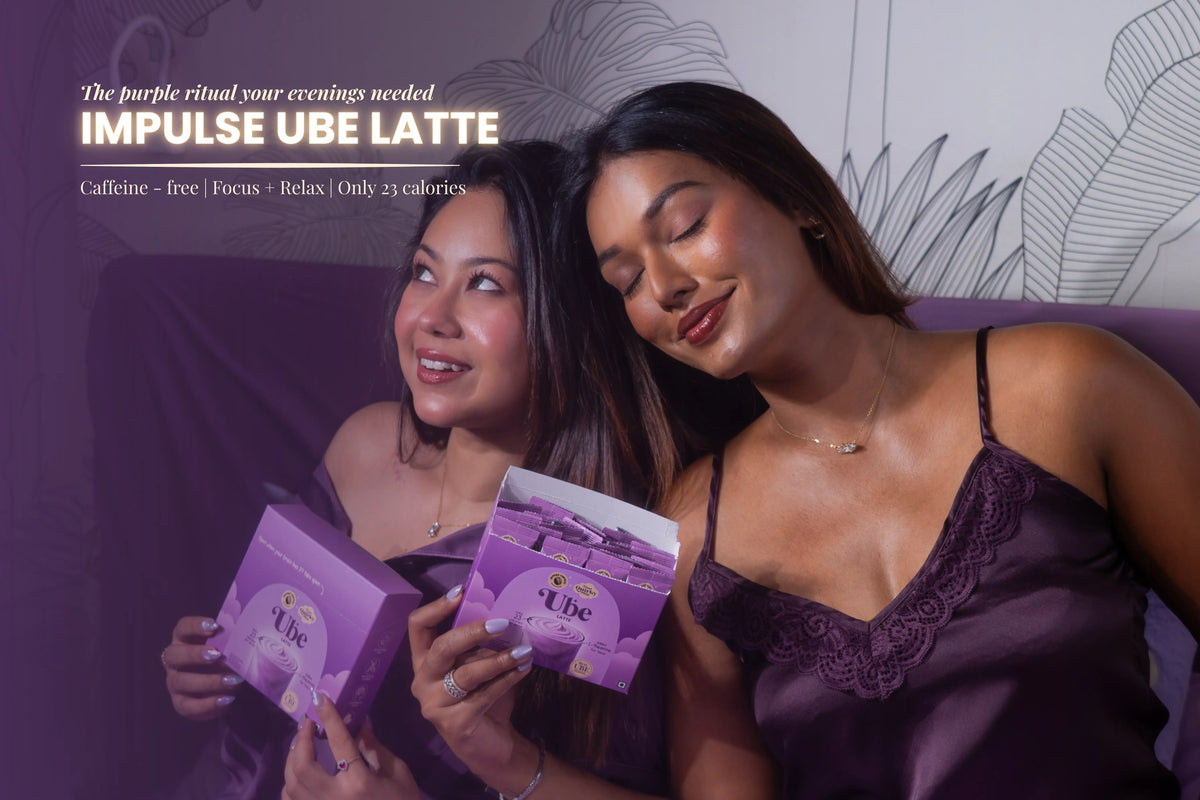
IMPULSE COFFEES x THAT QUIRKY MISS
What Is an Ube Latte? Benefits, Taste, and How to Make It at Home
By Team Impulse Coffees | Every batch is tested by an NABL accredited laboratory
Scroll through any food feed right now and one colour keeps stopping your thumb. That soft, dreamy labender. It is showing up in ice cream, in cheesecake, in soft serve, and most of all in tall, frothy glasses of something called an ube latte. If you have been wondering what an ube latte actually is, whether it tastes as good as it looks, and whether it is genuinely good for you, this is the only guide you need.
By the end of it you will know exactly what ube is, what it tastes like, why the internet is obsessed with it, and how to make a smarter, lighter version at home in under a minute. Let us start at the beginning.
What is ube, and what is an ube latte?
Ube is a purple yam, known to botanists as Dioscorea alata, and it is native to the Philippines where it has been a staple of desserts and celebrations for generations. Here in India, the same family of purple yam is often called ratalu or kand, so it is not as foreign to our kitchens as it first seems. That unmistakable violet colour is completely natural. It comes from anthocyanins, the same family of plant antioxidants that gives blueberries and red cabbage their rich hues.
An ube latte, then, is simply a creamy drink made by blending ube with milk. It is smooth, comforting, and naturally caffeine free in its traditional form, which is a big part of why it has become the drink people reach for when they want flavour without a coffee buzz.
So it looks stunning. But the real question everyone asks next is how it tastes.
What does an ube latte taste like?
This is the part that surprises people. Despite coming from a root vegetable, ube tastes nothing like potato and nothing earthy. It is mild, sweet, and nutty, with clear notes of vanilla and white chocolate and a soft hint of pistachio or coconut on the finish. Think of it as a gentle, dessert like flavour that feels indulgent without being heavy.
If you have ever enjoyed a vanilla milkshake or a white chocolate drink, an ube latte will feel instantly familiar, just with a creamier, more grown up character. That easy, crowd pleasing taste is exactly why it has spread so fast.
Why is ube suddenly everywhere?
A few years ago the aesthetic drink of the moment was matcha, with its calming green. Ube is the natural successor. Its vivid purple is made for the camera, which means every cup doubles as content, and its sweet, familiar flavour appeals to almost everyone who tries it. Global cafe chains and neighbourhood bakeries alike have leaned into it, and the trend has now travelled from Manila to feeds all over the world.
What is interesting for us in India is that the ube wave is only just beginning here. The curiosity is building, the searches are rising, but the shelves are still mostly empty. That gap is precisely where this next part comes in, because there is one honest question worth answering before you order your first cup.
Is an ube latte healthy? The honest truth
Here is the answer most brands will not give you plainly: it depends entirely on how the latte is made.
Pure ube itself is a genuinely smart ingredient. The purple yam is low in natural sugar, rich in the anthocyanin antioxidants that create its colour, and naturally plant based. On its own, it is the kind of food a nutritionist would happily nod at.
The problem is what usually happens to it at a cafe. To make that Instagram worthy cup, many commercial ube lattes are loaded with added sugar, sweetened condensed milk, and processed syrups or sweet ube jam. That turns a wholesome root vegetable into a dessert in a glass, often landing somewhere between 150 and 350 calories per serving. The ube is healthy. The version handed to you across the counter frequently is not.
This is the exact gap we set out to close. Which brings us to the difference in black and white.
Cafe ube latte vs the Impulse Ube Latte
Every number in the Impulse column below comes straight off our own pack, tested and verified. This is the honest comparison, no spin.
|
What you are drinking |
Typical cafe ube latte |
Impulse Ube Latte |
|
Calories per serve |
150 to 350 |
Only 23 |
|
Added sugar |
Often high, from syrups and condensed milk |
About 1 g per serve |
|
Sweetened with |
Refined sugar, syrups, ube jam |
Stevia and monk fruit |
|
Caffeine |
Often has an added espresso shot |
None, fully decaf |
|
L-theanine for focus |
None |
40 mg per serve |
|
Colour source |
Sometimes artificial |
Natural, from ube and purple sweet potato powder |
|
Effort |
Cafe only |
1 sachet, 100 ml cold milk, at home |
Same joyful purple, same creamy taste, a fraction of the calories and sugar, and something extra that a cafe cup simply does not offer. Let us talk about that.
Meet the Impulse Ube Latte: real Filipino ube meets Indian kesar
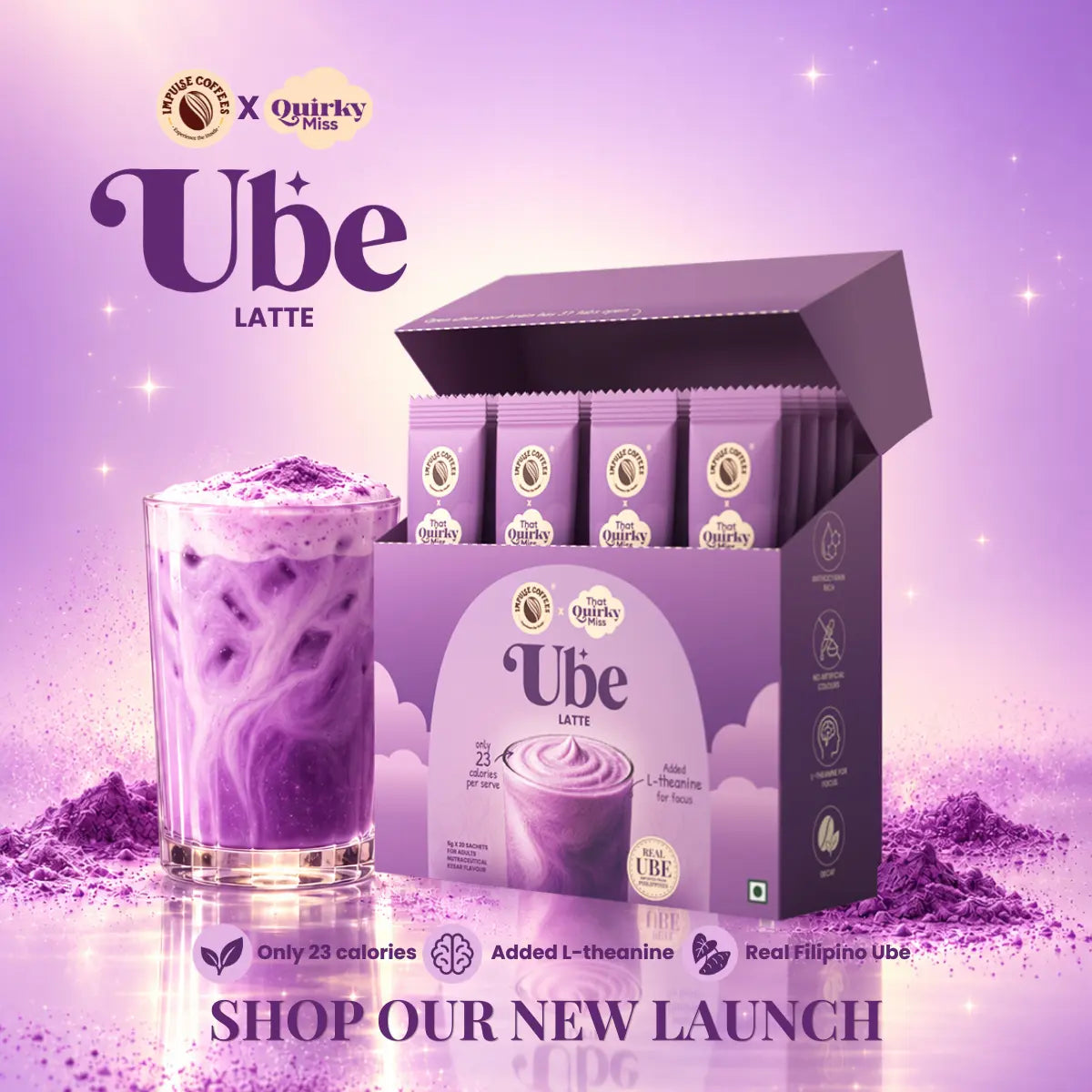
The Impulse Ube Latte is a collaboration between Impulse Coffees and That Quirky Miss a.k.a Aditi Shreshta, and the idea behind it is a little love story between two places. We bring real ube, imported from the Philippines, and pair it with rich kesar flavour inspired by India. Purple yam from one side of the map, the warmth of saffron from the other, in one calm, creamy cup built for your busiest days.
We designed it around three simple promises: calm, focus, and reset. Or as we like to put it, this is the drink to open when your brain has thirty seven tabs open. Here is what actually goes into that:
- Real Filipino ube. Genuine purple yam, not just a purple tint.
- Just 23 calories and about 1 g of added sugar per serve. A wellness drink, absolutely Guilt Free
- Sweetened with stevia and monk fruit. The sweetness comes from plants, not spoonfuls of sugar or artificial sweeteners.
- 40 mg of added L-theanine. The focus ingredient, more on this next.
- Completely decaf. All of the calm, none of the caffeine.
- Anthocyanin rich, with natural antioxidants. That purple is doing more than looking good.
- No artificial colours. The shade comes from ube, beetroot, and purple sweet potato.
- Plant based and vegetarian. Built on coconut milk and coconut creamer, so it is dairy free in the mix.
One ingredient on that list is the reason this is not just another pretty drink. Let us give it the spotlight it deserves.
L-theanine and focus, without the caffeine jitters
L-theanine is an amino acid most famously found in tea leaves. In the wellness world it is loved for one particular feeling: a calm, clear kind of alertness. The sense of being switched on and settled at the same time, rather than wired and restless.
Every Impulse Ube Latte sachet carries 40 mg of added L-theanine. And because the drink is fully decaf, that focus is not riding on a caffeine spike. There is no jitter, no mid afternoon crash, and nothing to get between you and your sleep at night. It is a cup you can enjoy at 4 pm on a deadline day and still switch off in the evening.
The short version: a cafe ube latte often gives you sugar and an espresso shot. The Impulse Ube Latte gives you calm, focused energy with only 23 calories and no caffeine at all.
Now for the best part, which is how easy it is to make one whenever you want it.
How to make an ube latte at home
No barista, no equipment, no queue. The Impulse Ube Latte is built for a busy day, so the method is almost embarrassingly simple.
- Take one sachet, 5 g of Ube Latte powder, and add it to a tall glass.
- Pour in 100 ml of cold milk.
- Froth or stir well until the mix turns smooth, creamy, and that signature purple.
- Enjoy straight away.
That is the whole recipe. Once you have the basics down, it is easy to make it your own:
- Iced ube latte. Add a few cubes of ice and stir for a chilled, cafe style version.
- Warm ube latte. Prefer it cosy? Use warm milk and whisk until frothy.
- Plant based, your way. Oat, almond, or coconut milk all work beautifully.
- Thicker and creamier. Use a little less milk for a dessert like, spoonable texture.
Still have a question rattling around? The most common ones are answered below.
Ube latte FAQs
What is an ube latte?
An ube latte is a creamy, vibrant purple drink made by blending ube, the Filipino purple yam, with milk. It tastes sweet, nutty, and vanilla like. Traditional versions are naturally caffeine free, though cafes often add an espresso shot. The Impulse Ube Latte is fully decaf and ready in under a minute at home.
What is ube, and what is it called in India?
Ube is the Filipino name for the purple yam, Dioscorea alata, a starchy root vegetable with brown skin and a bright violet inside. In India, related purple yam is commonly known as ratalu, kand, or simply purple yam, with names varying by region.
What is ube made of?
Ube is a whole root vegetable, a purple yam native to Southeast Asia. Its natural violet colour comes from anthocyanin antioxidants, and it is made up mostly of complex starches. It tastes sweet and nutty with hints of vanilla, nothing like an ordinary potato.
What does an ube latte taste like?
Creamy, smooth, and mildly sweet, with clear notes of vanilla and white chocolate and a soft, nutty finish like pistachio or coconut. Despite coming from a purple yam, it does not taste earthy or vegetable like. It is closer to a gentle dessert in a glass.
Is ube Filipino or Japanese?
Ube is Filipino. The word itself is Tagalog for the purple yam, which is native to the Philippines and central to Filipino desserts like ube halaya. It is also often confused with taro, but the two are different plants, and ube is far sweeter and more purple.
Why is ube suddenly so popular?
Two reasons. Its striking natural purple is made for social media, and its sweet, vanilla like flavour appeals to almost every palate. After the rise of matcha, cafes and bakeries worldwide adopted ube as the next big aesthetic and flavour trend, and the wave is now reaching India.
Is an ube latte healthy?
It can be. Pure ube is low in sugar, plant based, and rich in antioxidants. The catch is that many cafe versions add heavy sugar, condensed milk, or syrups that turn it into a high calorie dessert. A lighter option like the Impulse Ube Latte keeps the good parts at only 23 calories with about 1 g of added sugar.
Is an ube latte high in calories?
A typical cafe ube latte is moderately high, often 150 to 350 calories per serving, because the calories come mostly from milk, added sugar, and sweet ube jam rather than the ube itself. The Impulse Ube Latte is made to sidestep that, at just 23 calories per serve.
Is an ube latte naturally sweet?
Yes. Ube has a naturally mild, vanilla like sweetness, which is part of its charm. Cafe versions usually pile on extra sugar or sweet jam on top of that. The Impulse Ube Latte leans on the natural sweetness instead, rounded off gently with stevia and monk fruit.
Is ube high in sugar?
Pure ube is not high in sugar. The raw yam contains very little natural sugar and is mostly complex starch and fibre, though it is high in carbohydrates overall. Any high sugar reputation usually comes from what gets added during cooking, not from the yam itself.
A quick, honest note. The Impulse Ube Latte is a nutraceutical made for adults and is not intended to diagnose, treat, cure, or prevent any condition. If you are pregnant, nursing, or managing a medical condition, please consult your dietitian before adding it to your routine. Made in India. Tested by an NABL accredited laboratory.
Ready to try the purple drink everyone is talking about?
Ube is about to have its moment in India, and you get to taste it before the crowd. The Impulse Ube Latte gives you the full experience, the colour, the creamy vanilla and kesar flavour, and the calm, focused feeling, at only 23 calories with no caffeine and barely any sugar. One sachet, 100 ml of cold milk, and a minute of your time.
Try the Impulse Ube Latte here: Our Ube Collection and see what all the fuss is about. You might just wonder where ube has been all your life.
Calm. Focus. Reset. That is the Impulse way.

Leave a comment
This site is protected by hCaptcha and the hCaptcha Privacy Policy and Terms of Service apply.